
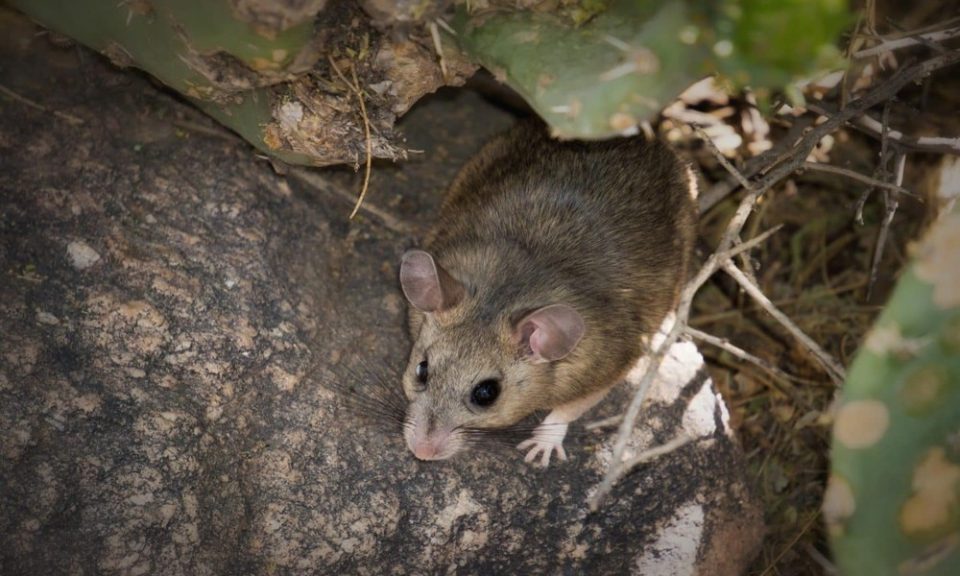
Most Tucson homeowners who live up against the desert eventually meet a pack rat. The first sign is rarely the rat itself. It’s a pile of cactus pads stacked under a parked car, or a chewed wiring harness that turns into a four-figure repair bill at the mechanic, or the smell coming out of an outdoor AC unit on the first hot week of May. Swift Pest gets calls about pack rats from the Catalina Foothills, Oro Valley, Catalina, Saddlebrooke, and the Tanque Verde area more often than from anywhere else, and the pattern is consistent enough that it’s worth understanding before the damage starts.
The animal in question is Neotoma albigula, the white-throated woodrat. They’re native to the Sonoran Desert, they’ve been here far longer than any of us, and the strategies that work on house mice or roof rats often don’t apply to them.
What a Pack Rat Actually Looks Like and Why That Matters
A white-throated woodrat is bigger than a mouse and stockier than a typical roof rat. Adults run six to eight inches in body length plus another six to seven inches of tail. They have large dark eyes, prominent ears, and a noticeably furred tail rather than the bare scaly tail of a Norway rat. The underside is white, which is where the name comes from.
The reason identification matters is that the species drives the strategy. Pack rats don’t behave like commensal rodents. They aren’t trying to live in your pantry. They’re desert animals using your property as habitat, which means baits placed indoors do almost nothing. The animal causing the damage is rarely inside the house in the first place.
How to Spot Pack Rat Activity Before It Costs You Money
The middens give them away. A pack rat midden is a pile of collected material, usually built around the base of a cholla, prickly pear, mesquite, or against a rock outcrop. They cover the den with cholla joints and prickly pear pads as a defensive layer, and they stockpile anything they find interesting. People have pulled keys, jewelry, golf balls, brass shell casings, and entire collections of bottle caps out of middens. The pad-and-cactus pile is the giveaway.
When pack rats move closer to a house, the midden often shows up under a parked vehicle, behind an outdoor AC condenser unit, on top of a pool pump enclosure, in a stack of firewood, or inside a rarely-used garage. The pile of cholla pads alone is enough to confirm what you’re dealing with.
Other signs worth watching for:
- Latrine areas with dark, glossy droppings about half an inch long, often clustered in the same spot week after week
- Gnaw marks on landscape drip lines, irrigation valves, and electrical conduit
- Greasy rub marks along walls or beams in attics where they travel
- A musky odor near the AC unit or in the garage that wasn’t there before
The latrines are particularly useful for tracking activity because pack rats are creatures of habit. They use the same toilet area for months, which makes baited stations and exclusion work much more effective when placed accordingly.
Why They Destroy Vehicles, AC Units, and Attics
Three property features account for most of the damage Swift Pest sees in foothills neighborhoods.
Vehicle wiring is the most expensive. Pack rats climb up through the suspension into the engine compartment, often using the warmth of a recently-driven engine as the draw. Once they’re up there, they chew. Modern vehicles use soy-based wire insulation that rodents seem to find especially appealing, and a pack rat can sever a wiring harness in a single night. Replacement quotes routinely run $1,500 to $5,000, and some homeowners go through the cycle twice before they realize what’s happening. Parking inside a sealed garage when possible, leaving the hood open under a bright light, or running peppermint deterrents under the engine are all stopgaps. None of them solve the underlying property issue.
Outdoor AC condenser units offer warmth, shade, and protected nesting space against the side of the house. Pack rats build inside the unit cabinet, chew through insulation on copper line sets, gnaw the low-voltage wiring that runs the contactor and capacitor, and create blockages that force the system to overheat. AC repair calls in May and June often turn out to be rodent damage from the previous winter.
Attics are the third high-value target. Pack rats climb into attic spaces through gaps where roof flashing meets stucco, around plumbing vents, and through gable vents that have lost their screening. Once inside, they gnaw on wiring, contaminate insulation, and create fire hazards that don’t show up until a homeowner notices a flickering light or an electrical smell.
Why Exclusion Beats Poison Every Time
A pack rat colony lives outdoors. Killing one or two animals with bait does not solve the problem because the territory remains attractive, and another animal moves in within weeks. Worse, pack rats sometimes carry the bait back into the midden where non-target animals like Harris’s hawks, great horned owls, and family pets can be exposed.
The strategy that actually works is removing the conditions that drew them in. Middens get dismantled. Cholla and prickly pear that touch the house get pruned back. Rock piles and stored materials against foundations get cleared. AC units get screened with hardware cloth. Garage door seals get replaced. Attic entry points get sealed with metal flashing. Where trapping is appropriate, snap traps placed along travel paths work well, and they remove the animal without leaving poisoned carcasses in the desert.
What Foothills and Desert-Adjacent Homeowners Should Be Doing
Properties up against natural desert in Oro Valley, the Catalina Foothills, and Tanque Verde face the highest pressure. A few practical habits make a real difference. Walk the property quarterly and look for new midden activity, especially in landscape rock and around AC units. Park inside when possible, or rotate which vehicle sits outside overnight. Check the engine bay periodically for nesting material. Keep cholla and dense brush a minimum of three feet from the house, the AC, and any parked vehicles. The Arizona-Sonora Desert Museum and University of Arizona Cooperative Extension both publish identification resources worth bookmarking for anyone new to desert living.
Pack rats are part of the Sonoran Desert. The goal isn’t to eliminate them from the landscape, it’s to make your specific property unappealing enough that they nest elsewhere. Swift Pest handles this kind of work across the foothills regularly, with property assessments that identify the actual middens, the entry points, and the exclusion work each home needs. If you’ve found cactus pads under your truck or you’re hearing scratching above the bedroom ceiling, schedule an inspection through Swift Pest before the next wiring harness goes.
