
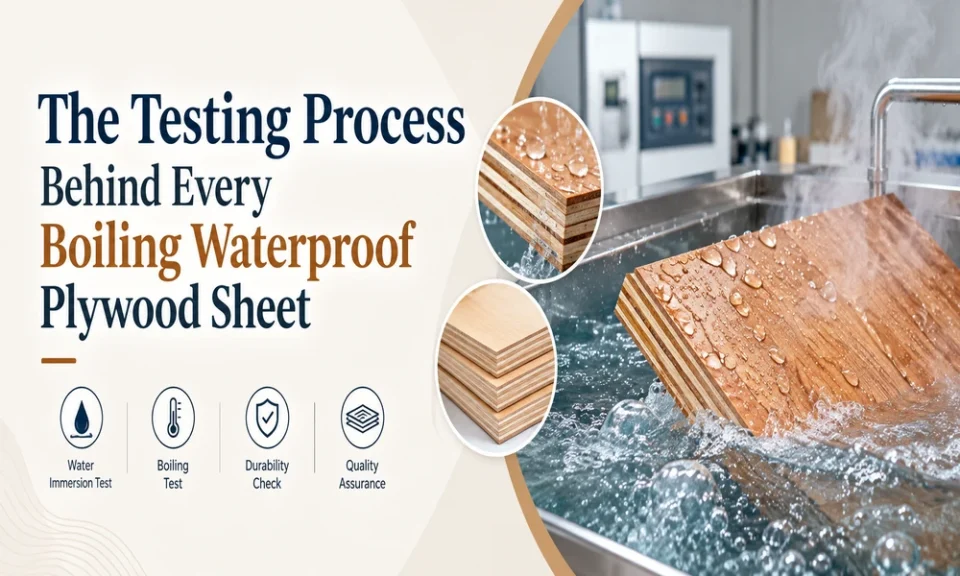
A plywood sheet may appear well-constructed at the factory, but you cannot determine its performance in humid conditions just by looking at it. When the plywood is used in environments such as kitchens, bathrooms or utility spaces, the adhesive bond between the veneer sheets must be ensured.
Now this is the stage when testing is applied. The High quality Boiling Waterproof plywood is produced and tested to guarantee its ability to resist the adverse effects of moisture.
1. How Testing Begins with Plywood Construction
The efficiency of the Boiling Waterproof plywood depends on the way the plywood sheet is made. The plywood comprises layers of wooden veneer placed perpendicular to each other and glued.
As mentioned in the source, the Boiling Waterproof plywood uses phenol-formaldehyde resin as glue. Therefore, once the adhesive has cured, the plywood becomes waterproof.
The source mentions the following steps of the manufacturing process:
- Selection of veneers with uniform thickness
- Treatment of veneers with chemicals
- Application of phenol-formaldehyde resin
- Hot-cooking the plywood sheets
- Cutting and finishing the ready-made sheets.
The quality of these manufacturing stages influences the quality characteristics of the resulting plywood sheets.
Adhesion Testing of Plywood
Adhesion testing evaluates the bond between the veneers of plywood. The problem of delamination is something that needs to be kept in mind when using plywood that can come into contact with water. Thus,careful consideration of the adhesive that holds the different plies together is required. The data from Royale Touche provided includes figures that show the adhesion strength of the glue in dry and wet conditions. The dry condition shows that the average glue adhesion strength is higher than 1,590 N, and the highest figure is 1,310 N. The knife test for adhesion of the plies showed excellent results.
The wet condition shows that the average glue adhesion strength is higher than 1,190 N, while the highest figure is above 1,020 N as well. Again, the knife test for adhesion of the plies showed great results. That is why the fact that adhesive quality is crucial for the construction of waterproof plywood is proven.
The 72-Hour Boiling Water Test
The 72-Hour Boiling Water Test is very important for Boiling Waterproof plywood. As mentioned in the available information, waterproof plywood is exposed to boiling water for 72 hours, which is good enough to test the adhesive bond in extremely tough conditions. It is important to note that the aim here is not the reproduction of the real-life use of the plywood in the conditions of boiling water. Most furniture is not exposed to boiling water in everyday practice.
Instead, the test gives a tough assessment of the ability of bonded timber to resist stringent moisture conditions.
After undergoing this test, the plywood is tested for such properties as wet adhesion and the state of the invested layers of plywood. The testing carried out by Royale Touche gives results for wet glue adhesion and excellent results based on the knife test of bonded sheets after the boiling test.
Thus, this test is very important when it comes to estimating plywood materials for places affected by moisture.
Other Tests Exploring More than Just Water Resistance
Water resistance is just a part of what is connected with plywood operation. The given testing results of the company include the results of strength assessment, water absorption, screw holding, and biological resistance.
The following results were recorded:
- 24 hours of water absorption – 1-2%
- 48 hours of water absorption – 2-3%
- Screw holding – more than 265kg
- Tensile strength – more than 97N.
- Dry static bending – modulus of rupture above 58N/mm along the grain and above 49N across the grain.
The same source gives results of mycological testing conducted, where glue shear strength is above the 1170N whil, while the adhesion of layers is brilliant, and that of chemicals is 12.5kg/m³ for VPT treatment.
Overall, these tests give a wider view of plywood performance than just testing it for waterproofness.
How to Know Verified Waterproof Plywood
Testing in the plant is not the last stage in selection. A client should also make sure that the used plywood corresponds to the stated class or certificate of quality.
The information received indicates that certified plywood always has the ISI mark, the number of the certificate, the respective Indian Standard code, and the data on the maker.
One should check that hooded plywood has IS:710 and moisture-resistant plywood has IS:303 marking.
Before buying plywood, one should check:
- The details of the certification
- The relevant Indian Standard code
- The company
- Class of plywood
- Size of the sheet
- The accompanying documentation
One can check the edge of plywood for the quality of construction as well.
Royale Touche also puts forth testing results for water absorption, screw holding, adhesion, as well as strength.
Conclusion
In conclusion, it should be said that the performance of Boiling Waterproof plywood depends on its construction and testing.
The 72-hour boiling water test provides a demanding assessment of how the bonded plywood structure responds to prolonged water exposure. Tests for adhesion, water absorption, strength, screw holding and biological resistance provide further measures of the sheet’s performance.
For buyers, the practical approach is to look beyond the surface. Check the plywood grade, certification, manufacturer details and available test information before making a purchase. A certified waterproof plywood sheet represents a defined performance specification supported by testing rather than simply a claim printed on the product.
